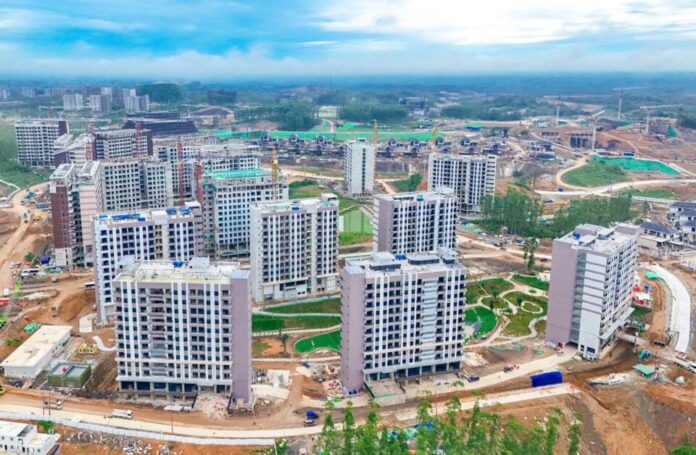
Deep in the forests of East Kalimantan, on the island of Borneo, Indonesia is building something few nations ever attempt: an entirely new capital city from scratch. Its name is Nusantara—a word drawn from Old Javanese meaning “the archipelago.” It is both a nod to Indonesia’s maritime past and a declaration of its future.
This is not just an infrastructure project. It is a national reset.
Why Leave Jakarta?
For more than 75 years, Jakarta has been the political and economic heart of Indonesia. But the megacity, home to over 10 million people (and nearly 30 million in the greater metropolitan area), is buckling under its own weight.
Jakarta’s challenges are immense:
- Sinking land: Parts of North Jakarta are sinking by up to 25 centimeters per year due to excessive groundwater extraction.
- Flooding: Seasonal monsoons regularly inundate neighborhoods.
- Traffic gridlock: Commutes can stretch for hours in one of the world’s most congested cities.
- Overcrowding: Java, the island where Jakarta sits, holds more than half of Indonesia’s population on just 7% of its land area.
Success has become strain. Jakarta drives Indonesia’s economy, but it also highlights a long-standing imbalance: development concentrated in Java while outer islands lag behind.
The Vision Behind Nusantara
The idea of moving the capital isn’t new. Indonesia’s founding president, Sukarno, once dreamed of relocating the capital to central Borneo in the 1950s. He envisioned a city that would symbolize unity across Indonesia’s thousands of islands.
Decades later, President Joko Widodo revived that ambition. In 2019, he announced the plan to move the capital to East Kalimantan—strategically located near the geographic center of the archipelago, and far from the seismic and volcanic risks that shadow Java.
Nusantara is designed as a “smart forest city.” Planners promise:
- 65% green space
- Renewable energy systems
- Walkable neighborhoods
- Integrated public transport
- A government district shaped symbolically like a Garuda, Indonesia’s national emblem
The city aims to house government functions first, with a long-term population target of nearly two million people.
This is urban design as national storytelling—a city meant to embody sustainability, technological innovation, and inclusivity.
A Promise of Balance
For many Indonesians outside Java, Nusantara represents long-awaited recognition. Building a capital in Kalimantan signals that Indonesia is more than Jakarta, more than Java—it is Sumatra, Sulawesi, Papua, Bali, and thousands of islands in between.
Economically, the project is expected to stimulate development in eastern Indonesia, create jobs, and reduce the overwhelming pull of Jakarta. Politically, it may foster a stronger sense of unity across a sprawling archipelago of more than 17,000 islands.
There is also symbolism in the name itself. “Nusantara” evokes the pre-colonial Majapahit era, when the concept described a vast maritime realm connecting islands through trade and culture. In reclaiming that term, Indonesia ties its future to its deep historical roots.
The Challenges Loom Large
Yet grand visions meet real-world obstacles.
Environmental concerns: Kalimantan is home to rich biodiversity, including endangered orangutans. Critics worry about deforestation and ecological disruption.
Funding: The project carries a multi-billion-dollar price tag, and while Indonesia seeks public-private partnerships and foreign investment, economic uncertainties persist.
Social impact: Indigenous Dayak communities live in the region. Ensuring their rights, culture, and land are respected is critical.
Will people move?: Building government offices is one thing; convincing civil servants, businesses, and families to relocate is another. A capital cannot thrive on symbolism alone—it needs schools, hospitals, culture, and soul.
And Jakarta will not disappear. It will remain Indonesia’s commercial powerhouse, meaning the country must effectively manage two major centers of gravity.
A Leap of Faith
Throughout history, new capitals have marked turning points—think Brasília in Brazil or Canberra in Australia. Nusantara joins this rare lineage: cities born not from gradual evolution but from deliberate national ambition.
There is something undeniably audacious about building a city from zero. It requires belief—not only in concrete and steel, but in identity and destiny.
For Indonesia, Nusantara is more than a relocation. It is a statement: that the country can confront its structural challenges head-on; that sustainability can guide growth; that the archipelago’s future need not be confined by the limits of its past.
Yet it is also a test. Can vision overcome bureaucracy? Can sustainability survive rapid development? Can unity be engineered?
The cranes rising above Kalimantan’s forests are symbols of hope—and of risk.
Indonesia is attempting something extraordinary: reshaping its map to reshape its future. Whether Nusantara becomes a thriving, green capital or a cautionary tale will depend on execution, inclusion, and patience.
But one thing is certain: few stories in the Asia-Pacific today capture the imagination quite like this one.
Image by pkp.go.id

